Iodobacter
To grow microorganisms such as bacteria, yeast, or fungi, several different arameters must be optimized, monitored and controlled. Therefore, a bioreactor with several sensors, pumps, and aeration management is required. The microorganisms are grown under axenic (only one organism is present) conditions to achieve high reproducibility. The microorganisms grow in the dark, using a carbon source such as glucose, depending on their needs.
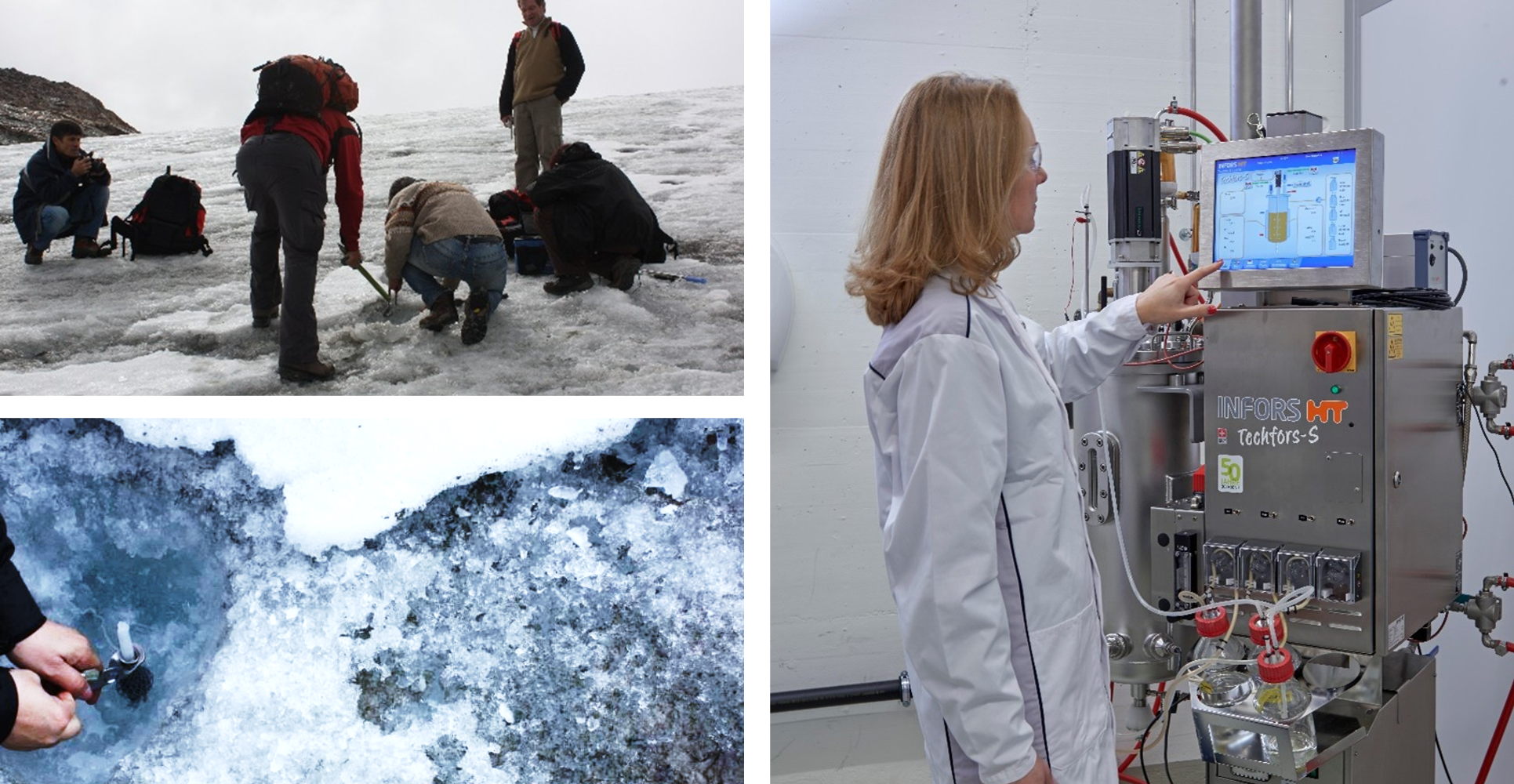
Extremophile organisms are masters of survival by being able to adapt to conditions generally considered as hostile to life. In order to adapt to these conditions, extremophiles developed various strategies which help them to cope with these stresses. To discover and harvest novel extremophile microorganisms for use in cosmetics, an expedition was undertaken together with specialists from the University of Santiago, Chile.
The expedition took place on a glacier located close to Zermatt, Switzerland, and the goal of the studyas to discover microorganisms that grow in such an environment in spite of the harsh conditions. Due to the constant shrinking of glaciers in the past decades, microbes that have previously been hidden below a permanent layer of ice are now accessible. Researchers from Mibelle Biochemistry took samples of extremophile bacteria from under the glacier, which was hidden below the ice for hundreds of years. Samples were then analyzed for their microbial content, and over 80 microbial strains were isolated. Whole-genome sequencing of an isolated strain led to the identification of Iodobacter ssp., which is a psychrotolerant, rod-shaped Gram-negative bacterium. Iodobacter produces violet pigments and exopolysaccharides. Greek ioeides refers to the violet color. Iodobacter is psychrotolerant, meaning it can tolerate and grow at temperatures close to freezing. We cultivate it in a non-violet form. For biomass production in a bioreactor, extensive development of growth conditions and media composition was necessary.